



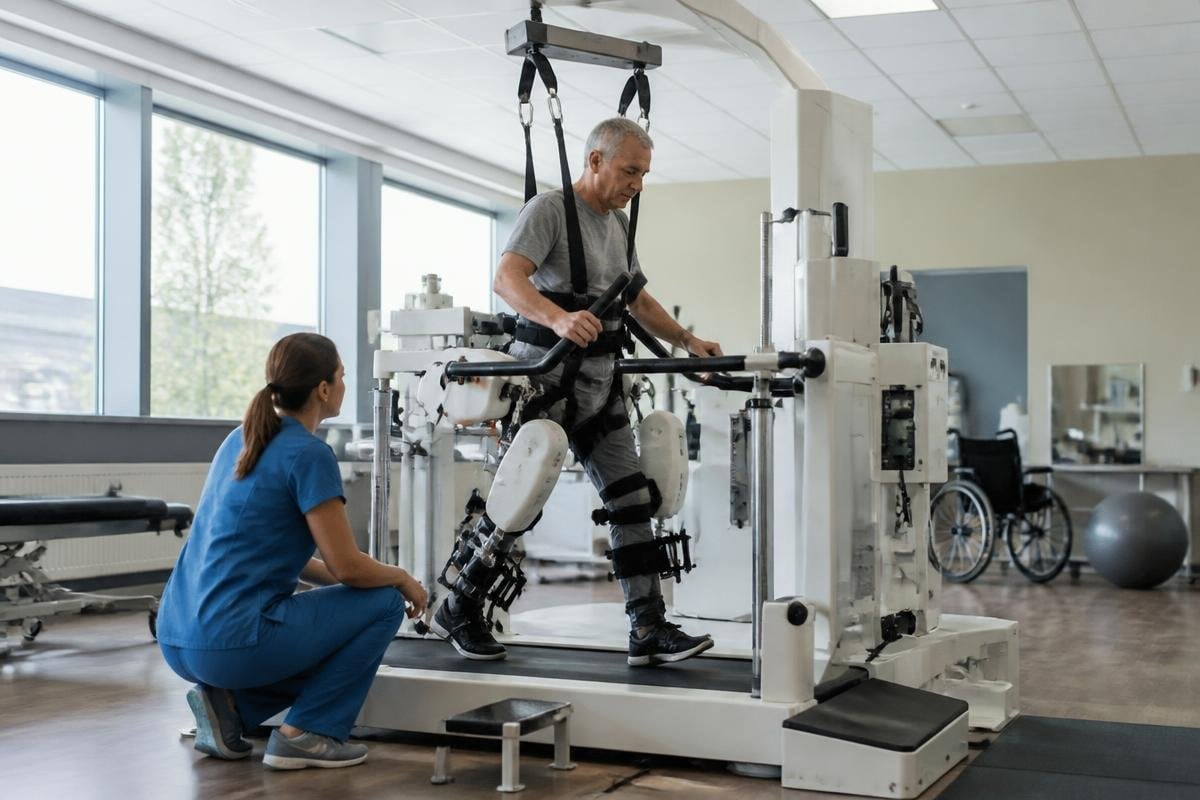
A person recovering from a stroke or spinal cord injury may need to practise the same walking motion many times. A rehabilitation robot can guide the legs, hold some body weight, and let a therapist adjust the task as movement returns.
- Robotic treadmills guide repeated steps while reducing the load on the legs.
- Powered exoskeletons use motors at the hips, knees, or ankles to assist walking.
- Sensors and software record how a person moves and adjust the session.
The main ways these robots help
Robotic treadmills combine a moving belt with a harness and leg supports. The harness can carry part of a person’s weight, while the robot helps place each foot and repeat a walking pattern. That gives the person more time practising gait, the technical word for the way someone walks.
The amount of help can change during a session. A therapist may reduce the support as the person gains control, or add help when fatigue causes the legs to buckle.
The useful part is the adjustment: the task can stay active without asking the person to carry more weight than they can manage.
Powered exoskeletons work differently. The frame attaches to the legs and uses motors to assist joint movement. Some systems help a person take steps on a treadmill, while others are built for walking across a floor with crutches, a walker, or another balance aid.
That difference matters. A treadmill session gives the therapist more control over speed and body weight. Floor walking asks the person to handle balance, turns, and changes in surface. The harder setting may be closer to daily life, but it also needs more supervision.
What the person still has to do
The robot can guide a leg, but the person still needs to take part in the movement. They may need to shift their weight, keep the trunk upright, place the foot, or start each step. Therapy works best when the system gives enough help for safe practice while leaving useful work to the patient.
Sensors can track joint angle, pressure under the feet, muscle activity, or the timing of each step. A therapist can use that information to see where movement breaks down. A machine that records a session can add detail, but it doesn’t replace a clinical decision.
The aim also changes over time. Early sessions may focus on standing and moving the legs safely. Later work may involve balance, speed, turning, or walking over ground. The robot has to fit that stage rather than repeat one fixed pattern.
A walking robot can assist a patient in a clinic without proving that the patient walks better after treatment. Reports on rehabilitation robots can compare the device, trial length, walking measure, and therapist’s role as these systems move toward clinical use.
Where the limits show up
A walking robot doesn’t repair damaged nerves or rebuild lost muscle by itself. It can give a person more controlled practice, but the change in walking depends on the injury, strength, balance, attention, and wider treatment plan.
Fit is another concern. The frame must match the person’s height and leg shape, and the harness must hold them securely without causing pain or pressure. A poor fit can change the walking pattern or make a session too tiring to finish.
Cost and access also shape the result. Large robotic treadmills need a clinic, trained staff, and enough room around the equipment. Wearable systems can support floor walking, yet they still need setup, charging, maintenance, and a plan for safe use outside therapy.
The evidence question needs care. A person may walk farther during a robot-assisted session because the machine is carrying part of the work. That result matters, but it isn’t the same as walking farther alone at home. Progress should be checked with ordinary walking tests and daily tasks as well as robot data.
A practical check before treatment
A clinic or care team can use these questions before choosing a system:
- Set the goal: is the session for standing, step practice, balance, or floor walking?
- Check the fit: can the frame and harness match the person without pain or pressure?
- Name the human work: which parts of each step must the person control?
- Plan the measure: will progress be checked during ordinary walking as well as with sensors?
- Set the exit plan: how will help be reduced as strength and balance change?
I’d choose a system by the movement it helps a person practise, not by the number of motors in the frame. The useful test is whether the person can carry more of each step when the robot gives less help.